Are Your Dog’s Nails Too Long? What the Click Test Can—and Cannot—Tell You
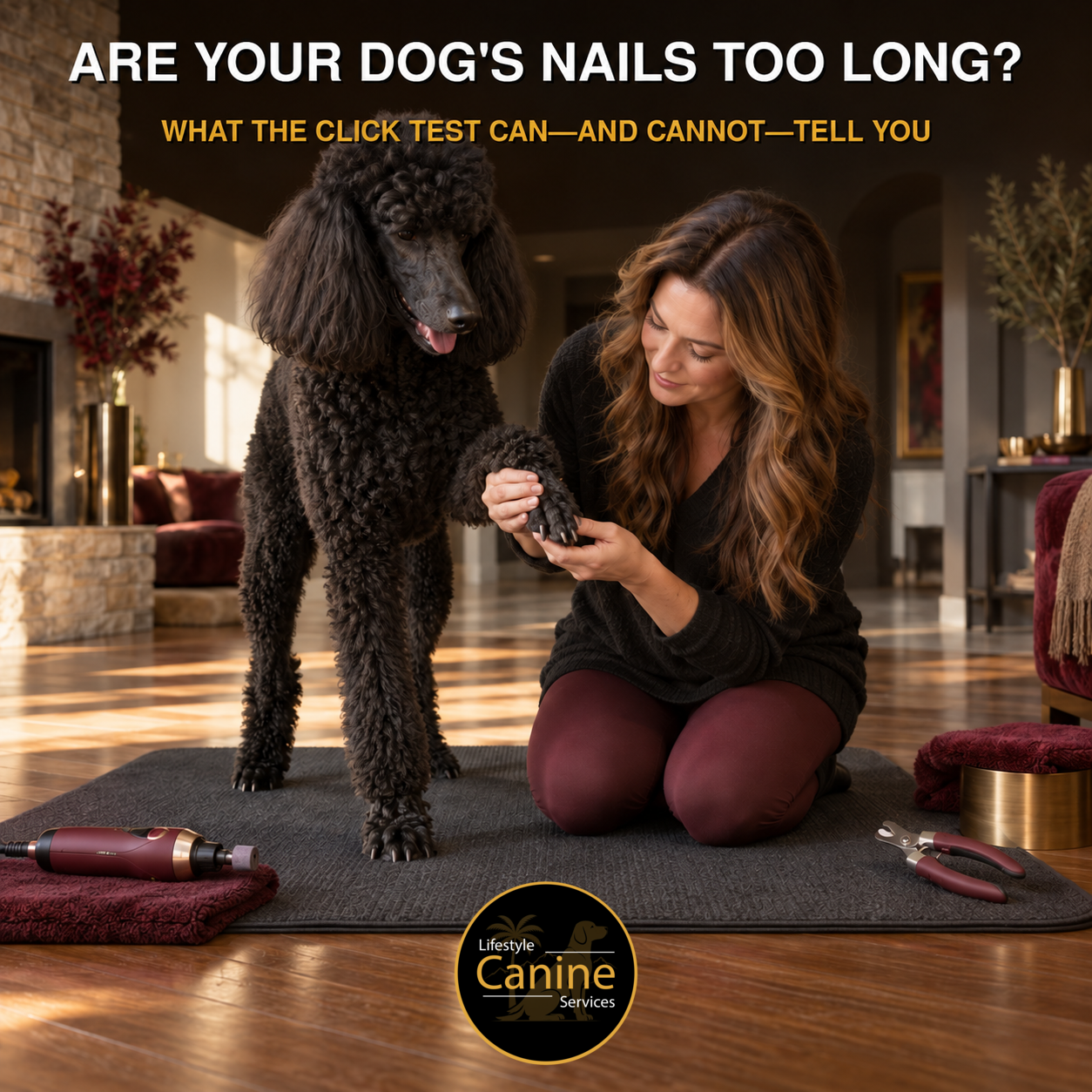
Many owners do not think about their dog’s nails until they hear steady clicking across the floor, notice a dewclaw beginning to curl or discover that the dog will no longer allow anyone to touch its feet.
Nail care is often treated as a cosmetic grooming detail. It is more accurately understood as part of the dog’s complete lifestyle: foot health, traction, comfort, movement, grooming cooperation, exercise and the owner’s ability to perform routine care safely.
The familiar advice says that if a dog’s nails click on a hard floor, they are too long. That sound is a useful reason to inspect the feet, but it should not be treated as a complete diagnosis.
Dogs differ in foot shape, nail angle, flooring, activity, age and movement. The proper goal is not to chase silence at any cost. It is to maintain safe, functional nails for the individual dog while noticing changes that may point to a larger problem.
What the Clicking Sound Means
Clicking means that at least one nail is contacting a hard surface during part of the dog’s step.
It may indicate that the nail needs shortening, particularly when the sound is new or becoming louder. However, the sound can also vary with:
The dog’s toe and nail conformation
The angle at which the nails grow
The speed and style of movement
The type of flooring
Whether the dog is turning, walking or trotting
The existing length of the quick
Orthopedic or neurological changes
Use clicking as a prompt to look—not as permission to remove a large amount of nail without evaluating what is safe.
What Healthy Nail Length Looks Like
There is no single measurement that suits every dog.
In practical terms, nails should not be curling toward the pad, forcing the toes out of position, snagging repeatedly or interfering with comfortable standing and movement.
Look at the dog while it stands naturally on a level surface. Then examine every foot individually.
Watch for:
Nails extending conspicuously beyond the paw
Nails resting heavily against the floor
Toes spreading or rotating
A nail curving toward the pad
Uneven wear between feet
One nail growing much faster than the others
Cracks, splits or rough edges
Redness or swelling around the nail bed
Licking or chewing at a toe
Reluctance to walk on certain surfaces
The foot should be evaluated as a unit. Nail length is only one part of it.
What New Research Adds to the Discussion
Owners are often told that long nails automatically change a dog’s entire posture and gait.
A February 2026 study published in Frontiers in Veterinary Science tested seven clinically healthy adult dogs on a pressure-sensitive treadmill before and after nail trimming.
The researchers did not find significant immediate changes in major global gait measures such as stride length, stance duration or vertical ground-reaction forces after trimming. They observed small paw-level differences, but those did not translate into broad locomotor changes in this small group of healthy dogs.
That does not mean nail care is unimportant. It means owners and professionals should avoid overstating what a single trim can accomplish.
Nails that curl into pads, break, split, snag or create localized pressure clearly require attention. Severely neglected nails can be painful. But if a dog is limping, moving abnormally or losing traction, trimming the nails should not replace an investigation into orthopedic, neurological, skin or foot problems.
The research also raises a useful possibility: unusually long or unevenly worn nails may sometimes be a result of altered movement and reduced natural abrasion—not necessarily the sole cause of the movement problem.
Nail Growth Reflects Lifestyle
How quickly a dog needs nail care depends on more than the calendar.
Important variables include:
Age
Genetics
Nail structure
Body size
Activity level
Walking surfaces
Foot conformation
Medical condition
Mobility
Season and climate
A dog walking frequently on abrasive surfaces may wear some nails naturally. A dog spending more time indoors, on grass or on soft desert sand may receive very little natural wear.
Hot weather can also reduce outdoor walking in The Coachella Valley. Even when limiting pavement exposure is the correct safety decision, less walking may mean the dog’s nails need more deliberate maintenance.
Why Dewclaws Are Easy to Miss
Dewclaws sit higher on the leg and often do not touch the ground. Because owners do not hear them clicking, they can become dangerously long while the other nails appear acceptable.
An overgrown dewclaw may:
Curve toward or enter the skin
Catch on blankets or furniture
Split or tear
Become hidden by a long coat
Cause pain when handled
Check every dewclaw during grooming. Some dogs have rear dewclaws, including double dewclaws, so count the nails instead of assuming every dog has the same arrangement.
Clippers or Grinder?
Both can work well when used correctly.
Clippers remove nail quickly. They can be useful for taking off length, but they create pressure through the nail and require accurate placement.
A grinder removes smaller amounts gradually and smooths sharp edges. It also produces sound, vibration and heat. Holding the grinder against one spot for too long can become uncomfortable.
The right choice depends on:
Nail thickness and color
The dog’s response to sound and pressure
The handler’s skill
How much length must be removed
Whether the nail is damaged
The quality and condition of the tool
Some professionals use clippers for the initial length and a grinder for shaping. The goal is safe control—not loyalty to one tool.
Understanding the Quick
The quick contains blood vessels and nerves. Cutting into it can cause pain and bleeding.
The quick may be visible as a pink center in clear nails. In dark nails, the handler must remove very small amounts and inspect the cut surface as the work progresses.
When nails are severely overgrown, the quick may also extend farther toward the tip. It is usually safer to shorten the nails gradually through more frequent sessions than to attempt an ideal length in one aggressive trim.
Keep styptic powder available before beginning. If bleeding persists, the nail is torn near its base or the dog is in significant pain, contact a veterinarian.
Nail Care Should Not Become a Wrestling Match
A dog that fights nail care may be afraid, confused, physically uncomfortable or experienced in escaping the procedure.
Balanced professional handling does not mean allowing frantic avoidance to control every decision. It also does not mean overpowering a panicked or painful dog simply to finish all four feet.
A fair plan combines:
A stable handling position
Clear expectations
Appropriate restraint
Gradual exposure to the tools
Reinforcement for cooperation
Calm interruption of avoidant behavior when appropriate
Short, successful sessions
Awareness of pain and medical limitations
The dog should learn that pulling, mouthing and spinning do not end necessary care, while calm cooperation produces praise, relief and release.
Build Cooperative Paw Handling First
Practice when the dog does not urgently need a major trim.
Progress through manageable steps:
Ask the dog to stand, sit or lie in a stable position.
Touch the shoulder and move down the leg.
Briefly hold the paw.
Touch individual toes.
Separate the coat from the nails.
Present the clippers or grinder.
Touch the inactive tool to one nail.
Turn the grinder on at a distance if it will be used.
Trim or grind one small amount.
Release the paw deliberately.
Do not rush from “the dog allowed one touch” to a complete pedicure. At the same time, avoid teaching the dog that every minor protest makes the procedure disappear.
Surface Traction Matters Too
A dog slipping on polished flooring may need more than shorter nails.
Inspect:
Hair growing between and over the pads
Dry, cracked or irritated pads
Weakness or pain
Excess body weight
Flooring without adequate traction
Rapid, uncontrolled movement indoors
Fear of the surface
Trim excess coat around the pads appropriately and provide nonslip runners or mats in high-use areas. Senior dogs and dogs recovering from injury may need a veterinary mobility assessment.
Do not assume that every slipping dog simply needs a closer nail trim.
Uneven Nail Wear Can Be Information
One foot or one nail wearing differently may reflect how the dog loads the limb.
Watch for:
Scuffing the tops of the nails
One rear foot wearing faster
Nails on one side remaining much longer
Drag marks
A changing stride
Reluctance to bear weight
Knuckling or placing the paw abnormally
These observations should be shared with a veterinarian. Nail maintenance may correct the length, but it does not diagnose the reason for abnormal wear.
When to Call the Veterinarian
Seek veterinary guidance when you notice:
A nail growing into the pad
Bleeding that does not stop
A split extending toward the nail bed
A partially torn nail
Swelling, heat, pus or odor
Persistent licking of one toe
A nail with an unexplained color or shape change
Limping or reluctance to bear weight
Repeated broken nails
Abnormal paw placement or dragging
Sudden resistance to previously tolerated handling
Do not attempt to pull off a partially attached nail. Damaged nails can be extremely painful, and even a normally gentle dog may bite.
What Owners Can Do
Inspect every nail, including dewclaws, at least weekly.
Notice changes in clicking rather than waiting for obvious overgrowth.
Watch the dog stand and move on several safe surfaces.
Keep foot hair maintained without injuring the pads.
Choose clippers, a grinder or a combination appropriate for the dog.
Remove small amounts when the quick is difficult to locate.
Maintain tools so they cut or grind efficiently.
Keep styptic powder accessible.
Practice calm paw handling between trims.
Use a nonslip surface during grooming.
Avoid forcing a painful or panicked dog through the procedure.
Track uneven wear, limping or changes in mobility.
Involve a veterinarian when the nail or movement appears abnormal.
ANYTIME the steps in our blog posts are beyond your ability to follow, or you struggle to facilitate them, schedule an in-person consultation with Canine Lifestyle Services. We can evaluate handling, grooming cooperation, household surfaces, movement and the owner’s ability to maintain the dog safely.
The Owner’s Role
The owner is responsible for more than scheduling a nail trim after the nails become visibly long.
Responsible maintenance includes checking the feet regularly, teaching the dog to accept handling, noticing changes in movement and knowing when the issue belongs with a groomer, trainer or veterinarian.
Waiting until the dog has severe overgrowth makes the procedure harder. Avoiding the feet because the dog protests allows both the behavior and the physical problem to progress.
Routine care should be taught as part of daily life.
The Canine Lifestyle Perspective
At Canine Lifestyle Services, nail care connects grooming, training, mobility, exercise, household surfaces and owner responsibility.
The clicking sound is useful information, but it is not the entire assessment. The complete dog matters: how the nails look, how the dog moves, what surfaces it uses, whether it can cooperate and whether pain or medical change may be involved.
If your dog fights foot handling, becomes defensive during nail care, slips repeatedly or has nail length that you cannot safely manage, schedule an in-person consultation with Canine Lifestyle Services. We can evaluate the dog directly and develop a practical cooperative-care plan around the dog’s needs and your lifestyle.
For continued education and discussion about canine training, behavior, grooming, wellness and daily structure, join the Canine Lifestyle Services App.
If you or someone you know could benefit from professional canine training and lifestyle support, please share Canine Lifestyle Services.
Frequently Asked Questions
Does clicking always mean my dog’s nails are too long?
Clicking means that a nail is contacting the floor and is a useful reason to inspect the feet. Nail angle, foot shape, flooring and movement can also affect the sound, so evaluate the complete foot before trimming aggressively.
Should a dog’s nails touch the floor while standing?
Many grooming guidelines recommend nails that do not rest heavily on the floor when the dog stands naturally. The appropriate length still depends on the dog’s anatomy, quick length and health.
Do long nails change a dog’s gait?
A small 2026 study of healthy adult dogs found no significant immediate changes in major gait measurements after trimming, although small paw-level differences were observed. Severely overgrown, ingrown or damaged nails can still cause localized pain and require care.
How often should dog nails be trimmed?
There is no universal schedule. Nail growth, activity, walking surface, age and health all matter. Inspect weekly and trim or grind often enough to prevent overgrowth.
Can walking on pavement replace nail trims?
Hard surfaces may wear some nails, but wear is often uneven and dewclaws generally receive little or none. Inspect every nail regardless of the dog’s walking routine.
Is a grinder safer than clippers?
Neither tool is automatically safer. Clippers can cut too deeply; grinders can create heat or catch coat. Safety depends on the tool, nail, dog and handler.
What should I do with severely overgrown nails?
Do not attempt to reach the ideal length in one session. A professional may recommend small, frequent reductions so the quick can gradually recede.
Why does my dog suddenly resist nail trimming?
Pain, a damaged nail, arthritis, fear or a previous negative experience may be involved. Sudden resistance after prior cooperation warrants careful inspection and possibly veterinary evaluation.
Why are my dog’s nails wearing unevenly?
Uneven wear may result from anatomy, activity or altered limb use. When it appears with limping, scuffing or abnormal paw placement, ask a veterinarian to evaluate the dog.