TRAINING IS THE BEGINNING. LIFESTYLE IS THE GOAL.
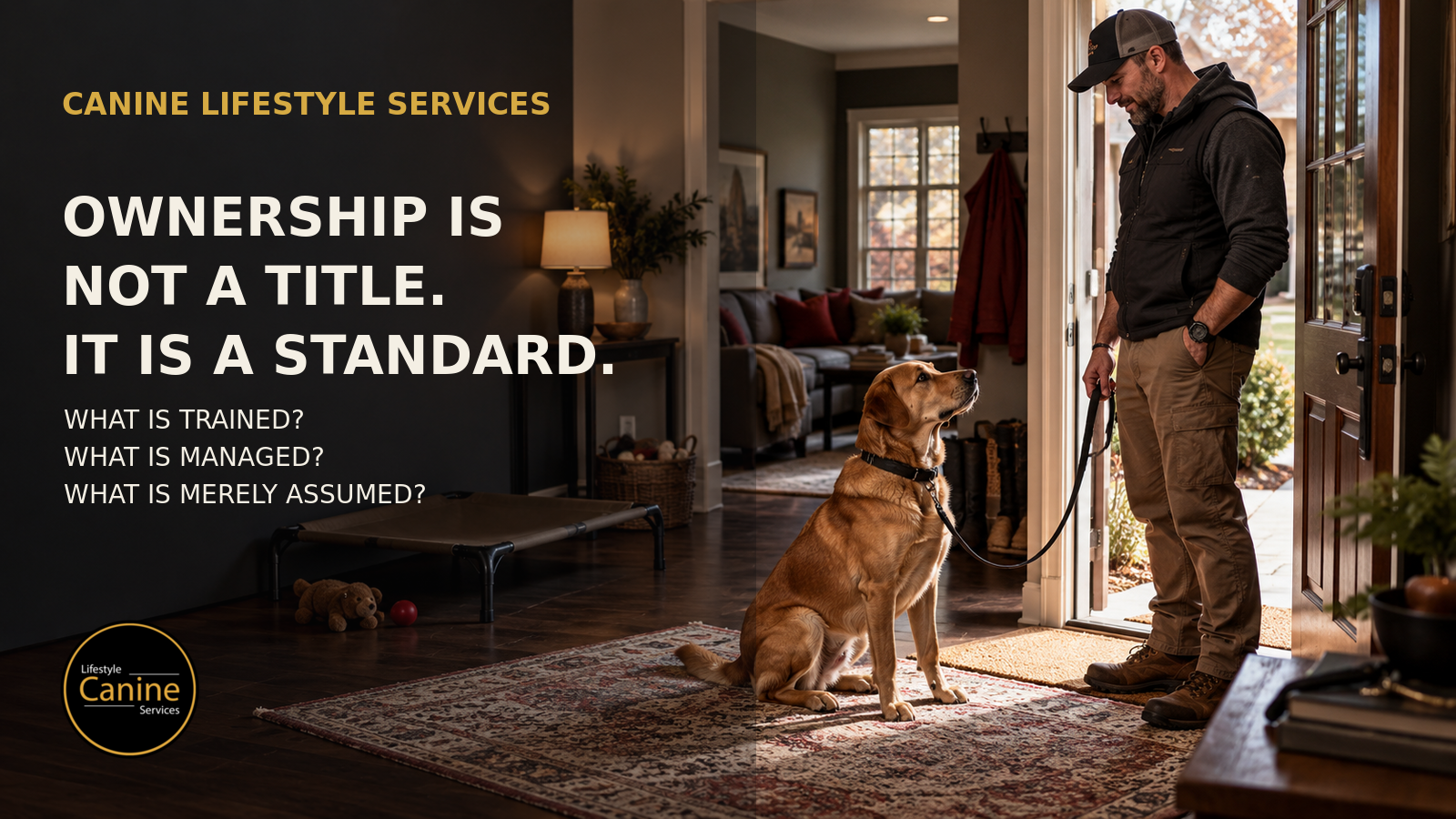
For many dog owners, training begins with a problem.
The dog pulls on the leash, ignores directions, rushes through doors, barks at visitors, reacts around other dogs or cannot settle inside the home.
The owner understandably wants the behavior to stop.
Training can address those problems—but teaching commands is only part of what I do.
My greater responsibility is helping owners bridge the gap between a dog performing trained behaviors and a family living successfully with that dog every day.
A DOG CAN KNOW COMMANDS WITHOUT HAVING A TRAINED LIFESTYLE
A dog may understand Sit, Down, Place, Come, Heel, Wait and Leave It.
That does not automatically mean the dog can:
Remain calm when visitors arrive
Walk appropriately through public spaces
Settle while the family eats
Enter and exit a vehicle safely
Ignore another dog across the street
Accept routine grooming and handling
Respect household boundaries
Respond when food is not visible
Maintain control as excitement increases
Travel comfortably with the family
Knowing a command and applying it during real life are different stages of training.
The first stage teaches the dog what a direction means.
The next stage teaches the dog that the same expectation applies in different environments, around distractions and during situations that matter to the owner.
That is where training begins becoming a lifestyle.
THE DOG CANNOT BE THE ONLY ONE EXPECTED TO CHANGE
I have worked with dogs professionally since 1986. One lesson has remained consistent throughout those years:
Successful training also requires owner education.
Owners need to understand:
What their dog is communicating
What happens before unwanted behavior begins
How their timing affects the dog
Which behaviors they may reward unintentionally
When management is necessary
When the dog needs more teaching
When fair accountability is appropriate
How equipment should be used
How to follow through without becoming emotional
How to maintain progress after formal training ends
A dog can return from a training program with stronger skills, but those skills must function within the owner’s household, schedule, physical ability and goals.
If the owner cannot understand or maintain the system, the training will gradually disappear.
Owner coaching is not an optional extra. It is part of responsible dog training.
TRAINING MUST FIT THE LIFE YOU ACTUALLY LIVE
Not every owner wants or needs the same lifestyle.
One person may want a dog who settles quietly while they work from home.
Another may want to travel, visit pet-friendly patios or stay in hotels.
A senior owner may need safe leash manners and dependable doorway control.
A busy professional may need a structured routine that remains manageable during demanding workweeks.
A family may need a dog who functions appropriately around children, visitors and household activity.
The training plan should support the life the owner and dog are realistically building together.
If a dog pulls, I do not only ask how to stop the pulling. I consider where the owner needs to walk, who handles the dog, what equipment is being used and what level of control the owner needs.
If a dog becomes reactive, I do not focus only on the explosion. I examine early warning signs, distance, handler tension, environmental pressure and recovery.
If a dog cannot settle, I consider structure, fulfillment, boundaries, independence and whether constant attention has become an expectation.
The visible behavior matters.
The lifestyle surrounding it matters too.
BALANCED TRAINING LOOKS AT THE COMPLETE PICTURE
My approach is based on balanced training.
That includes:
Clear teaching
Meaningful rewards
Appropriate motivation
Prevention and management
Structure and boundaries
Pressure and release
Fair, proportionate accountability
Consideration of health, fear, pain and physical ability
Honest evaluation of the owner’s handling
Balanced training does not mean correcting every unwanted action.
It means determining what the dog understands, what the dog can do, what the environment is producing and what the owner must change.
A dog should not be corrected for failing a behavior they were never properly taught.
At the same time, an owner should not remain permanently dependent on treats, distraction and avoidance when a trained dog is capable of responding to a reasonable direction.
The goal is communication that remains clear when real life becomes distracting.
FROM A TRAINING SESSION TO DAILY LIFE
The real test of training is not what happens during a controlled lesson.
It is what happens afterward.
Can the owner use the skill tomorrow morning?
Can another household member follow the same system?
Can the dog respond without the trainer nearby?
Can the behavior hold when the doorbell rings, another dog appears or the family travels?
Can the owner recognize when the dog is not ready and use responsible management instead of taking an unnecessary risk?
Training is not a certificate declaring the dog permanently finished.
It is a working system that becomes part of everyday life and must be maintained as the dog, owner and household change.
WHY CANINE LIFESTYLE SERVICES
Canine Lifestyle Services represents the broader work I provide.
Dog training remains central, but the complete canine lifestyle may also include:
Owner coaching
Behavior consultation
Puppy development
Household structure
Public manners
Travel preparation
Grooming cooperation
Physical conditioning
Breed-specific considerations
Virtual coaching
Continued education
The goal is not simply to produce a dog who performs commands during a lesson.
The goal is to help the owner understand how to live with, guide, manage and enjoy that dog responsibly.
Training should create more than obedience.
It should create access to a safer, calmer and more rewarding life together.
That is the bridge between dog training and the canine lifestyle.
If you are located in The Coachella Valley and need help moving beyond isolated commands into reliable everyday behavior, you can arrange an in-person consultation with me.
Virtual coaching is also available for dog owners outside the local area.
Learn more or schedule your consultation: