Car Anxiety or Motion Sickness?
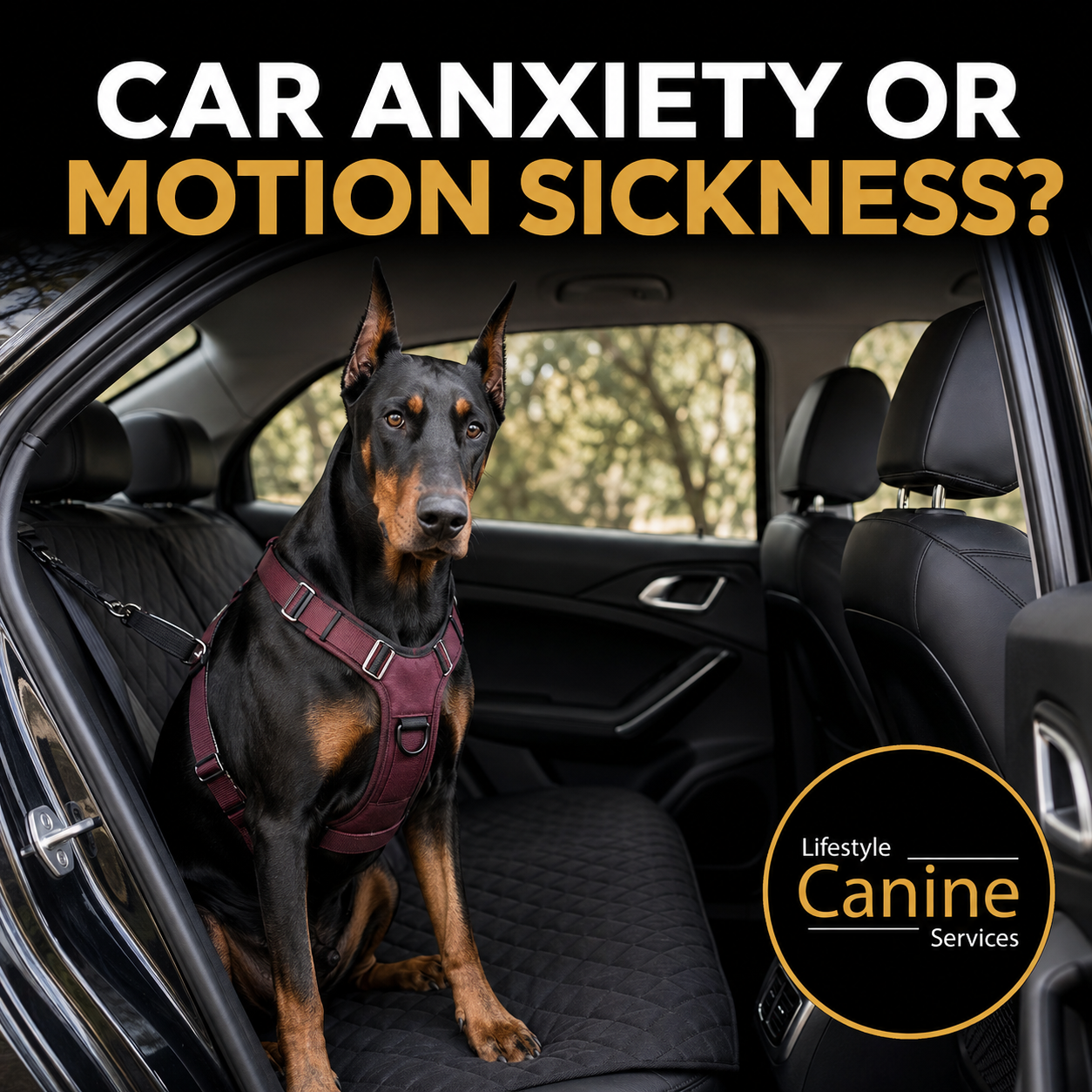
You pick up the keys, and your dog disappears into another room.
The dog may refuse to enter the vehicle, begin panting before the engine starts, pace across the back seat, drool excessively or vomit several minutes into the drive.
Owners frequently describe all of these behaviors as “car anxiety.”
However, a dog that struggles during travel may be experiencing emotional distress, physical motion sickness or a combination of both.
The distinction matters.
Training can help change the dog’s emotional response to the vehicle, but training alone may not resolve physical nausea. Medication may control motion sickness, but medication alone may not repair a fearful association created by repeated unpleasant trips.
A complete plan considers the dog’s health, previous experiences, travel equipment, emotional response, physical symptoms and the owner’s handling before, during and after every ride.
Why Dogs Develop Problems With Car Travel
A dog may dislike the car because of:
Motion sickness
An immature balance system
Previous vomiting during travel
A frightening vehicle accident
Slipping or falling inside the vehicle
Loud engine or road noise
Unstable footing
Heat
Poor ventilation
Being forced into the vehicle
Insufficient early exposure
Every ride ending at the veterinarian or groomer
Separation from the owner inside a travel crate
An uncomfortable restraint system
Pain when jumping into or out of the vehicle
Generalized anxiety
A lack of predictable travel structure
A dog can also develop anticipatory anxiety after experiencing motion sickness.
If riding in the car repeatedly leads to nausea, the dog may begin feeling distressed before the vehicle moves. The sight of the car, sound of the keys or approach to the garage can predict the physical discomfort that previously followed.
At that point, motion sickness and anxiety reinforce one another.
Signs That Suggest Car Anxiety
Car-related anxiety often begins before meaningful vehicle movement.
The dog may become concerned when:
The owner picks up the keys
A travel bag is packed
The garage door opens
The leash is attached near the vehicle
The car door opens
The dog is asked to enter
The restraint or travel crate appears
The engine starts
Behavioral signs may include:
Hiding
Refusing to approach the vehicle
Pulling away
Freezing
Trembling
Panting before the car moves
Whining or barking
Attempting to climb into the owner’s lap
Scratching at the door
Repeatedly changing position
Refusing food
Attempting to escape
Urinating or defecating from distress
Becoming unusually still or shut down
A dog that remains completely motionless should not automatically be assumed calm. Some overwhelmed dogs stop visibly struggling while remaining highly distressed.
Owners should evaluate the entire body: breathing, muscle tension, facial expression, ear position, willingness to eat and ability to respond to familiar guidance.
Signs That Suggest Motion Sickness
Motion sickness frequently becomes more obvious after the vehicle begins moving.
Possible signs include:
Lip licking
Repeated swallowing
Excessive drooling
Yawning
Restlessness
A hunched posture
Nausea
Retching
Vomiting
Diarrhea
Lethargy
Reluctance to eat after travel
Puppies may be more susceptible because the structures involved in balance are still developing. Some improve as they mature, but owners should not repeatedly expose a sick puppy to long drives and hope the problem disappears.
Repeated nausea can teach the puppy that the vehicle predicts discomfort, creating an emotional problem that remains after the physical susceptibility improves.
Anxiety and Motion Sickness Can Look Similar
Panting, drooling, restlessness and vomiting can occur with physical nausea, emotional distress or both.
Timing provides useful information.
Ask:
Does the behavior begin when the keys appear?
Can the dog relax inside a parked vehicle?
Does distress begin only after movement?
Does the dog become worse on winding roads?
Is the dog more comfortable on short, straight trips?
Does vomiting occur at a predictable point?
Does the dog show nausea outside the car?
Has the dog ever been comfortable traveling?
Did the problem begin after a frightening event?
Does the dog resist jumping because of pain?
Is the travel surface secure or slippery?
A detailed history can help a veterinarian and trainer determine which components require attention.
Rule Out Pain and Medical Problems
A dog that suddenly develops travel difficulty should not automatically be labeled anxious.
Pain can make entering, balancing and exiting a vehicle uncomfortable. The dog may resist the car because climbing aggravates the back, hips, knees, shoulders or neck.
Other medical issues that can affect travel comfort include:
Ear disease
Vestibular problems
Gastrointestinal illness
Medication side effects
Vision changes
Neurological conditions
Respiratory disease
Pain
Age-related physical changes
Veterinary evaluation is particularly important when the problem begins suddenly, worsens rapidly or occurs with symptoms outside the vehicle.
Do Not Wait Until a Long Trip to Address the Problem
A holiday road trip is not the ideal time to discover whether a dog can tolerate two or three hours in the car.
Training should begin before travel becomes necessary.
A dog that can remain calm for three minutes in a parked vehicle is not automatically prepared for a long freeway drive. Duration, movement, turns, traffic, road noise and unfamiliar destinations add difficulty.
Build the skill in stages.
Begin Outside the Parked Vehicle
Some dogs become distressed several feet from the car.
If the dog is already pulling away, trembling or refusing food, immediately forcing it into the vehicle begins the session beyond a workable threshold.
Start where the dog can observe the vehicle while remaining functional.
That may involve:
Walking calmly past the parked car
Performing familiar skills near the vehicle
Approaching and moving away
Standing near an open door
Investigating the doorway
Placing the front feet inside
Entering briefly
Exiting calmly on direction
The owner should control the exercise without dragging the dog through escalating fear.
Progress should require cooperation, but the task must remain achievable.
Separate Entering the Car From Driving
Owners frequently combine too many steps.
The dog is brought to the car, lifted inside, restrained, the door closes, the engine starts and the vehicle immediately moves.
A dog that struggles has no opportunity to learn which part of the sequence is manageable.
Instead, practice individual components:
Approach the parked vehicle.
Enter and exit with the engine off.
Sit inside briefly with the doors open.
Practice the travel restraint.
Close one door.
Sit with all doors closed.
Start and stop the engine.
Back out and return.
Drive to the end of the street.
Complete a short trip to a neutral or enjoyable destination.
Move forward when the dog remains physically and emotionally functional at the current stage.
Create Better Associations Without Bribing Through Panic
Food, toys and praise can help develop positive associations, but rewards should be used thoughtfully.
If a dog is too frightened or nauseated to eat, repeatedly pushing food toward its face will not make the situation positive.
The inability to accept a normally valuable reward is useful information. It may indicate that the exercise has progressed too quickly or that the dog feels physically unwell.
Reward:
Calm approach
Voluntary entry
Remaining in the assigned area
Settling in the travel equipment
Responding to familiar guidance
Calm observation
Controlled exit
The objective is not to distract the dog from an overwhelming experience. It is to build an experience the dog can successfully process.
Keep Short Trips Meaningful
If every car ride ends at a veterinary clinic, grooming appointment or boarding facility, the dog may learn that the vehicle predicts an unpleasant or uncertain event.
Include short trips that lead to:
A calm walk
A brief training session
A familiar person
An appropriate outdoor area
A pleasant visit
A simple ride followed by returning home
The destination does not need to create extreme excitement. In fact, repeatedly driving to highly stimulating locations can produce frantic anticipation rather than calm travel.
The goal is a dog that views the car as a normal part of life.
Safe Restraint Supports Emotional and Physical Stability
An unrestrained dog can move unpredictably, distract the driver and be seriously injured during sudden braking or a collision.
Appropriate travel options may include:
A properly secured travel crate
A fitted automotive safety harness connected according to its instructions
A suitable carrier for a small dog
A stable back-seat travel arrangement
A vehicle barrier used with appropriate restraint
The dog should not be tethered by the collar. Sudden force applied to the neck can cause serious injury.
Dogs should also not:
Ride on the driver’s lap
Move freely between seats
Occupy a front passenger seat exposed to an airbag
Travel loose in an open truck bed
Hang their head far outside a moving vehicle
Be left alone in a parked vehicle
Introduce the restraint equipment outside the pressure of an actual trip. A dog that first encounters an unfamiliar harness or crate moments before departure may associate the equipment with stress.
Vehicle Setup Matters
Consider the physical environment inside the vehicle.
The dog may benefit from:
A cool cabin
Appropriate ventilation
Stable footing
Reduced visual motion through side windows
A familiar mat or blanket
Enough space to maintain a comfortable posture
A secure restraint
Calm handling
Predictable loading and unloading
A dog sliding across leather seats during every turn may become physically unstable and fearful. Adding a secure, non-slip surface can make travel more comfortable.
Some dogs feel better when facing forward. Others settle more effectively in a properly secured solid-sided crate that reduces visual stimulation.
The best arrangement depends on the dog, vehicle and restraint system.
Feeding Before Travel
Meal timing may influence motion sickness, but owners should not apply one rigid fasting rule to every dog.
Puppies, diabetic dogs, medically fragile dogs and dogs taking medication may have specific nutritional requirements.
Ask your veterinarian:
Whether meal timing should change
How long before travel the dog should eat
Whether water should be offered differently
Whether nausea medication is appropriate
Whether a trial dose is needed before the trip
Fresh water should remain available according to the dog’s needs, with planned bathroom breaks during longer travel.
Medication Can Be Part of a Responsible Plan
A veterinarian may recommend medication for nausea, anxiety or both.
Medication should not be viewed as failure. Preventing repeated vomiting or severe distress may make behavior modification more effective and travel more humane.
However:
Do not give human medication without veterinary guidance
Do not guess the dose
Do not combine products unless directed
Do not assume sedation treats the underlying fear
Test prescribed situational medication before an important trip when your veterinarian recommends doing so
Observe the dog for side effects
A sedated dog is not necessarily an emotionally comfortable dog. The plan should address both physical symptoms and learned associations.
What Owners Can Do
ANYTIME the steps in our blog posts are out of your ability to follow, or you struggle to facilitate them, seek professional training. An in-person professional can observe the dog’s behavior around the vehicle and help distinguish a training problem from signs requiring veterinary involvement.
Record when the first sign appears: before approaching, after entering, when the engine starts or only after movement.
Discuss repeated drooling, nausea or vomiting with your veterinarian before a long trip.
Rule out pain when a dog suddenly resists entering or exiting the vehicle.
Practice around a parked, cool vehicle before adding movement.
Break the travel sequence into manageable steps.
Use short practice rides rather than beginning with a long journey.
Include neutral and enjoyable destinations in the dog’s routine.
Use a properly secured crate, carrier or automotive safety harness.
Provide stable, non-slip footing.
Keep the vehicle cool and appropriately ventilated.
Plan water, bathroom and rest breaks during longer drives.
Introduce travel equipment before departure day.
Do not force an actively panicking dog through repeated long rides.
Never leave the dog alone in a parked vehicle.
Do not give over-the-counter or prescription medication without veterinary direction.
If the dog’s distress is escalating or you cannot load and secure it safely, build the plan with a professional before attempting another extended trip.
Watch the Dog After Travel
Recovery provides information.
After a short ride, note:
How quickly breathing returns to normal
Whether the dog accepts water or food
Whether nausea continues
Whether balance appears normal
Whether the dog remains unusually lethargic
Whether diarrhea develops
Whether the dog avoids the vehicle later
Persistent vomiting, weakness, abnormal balance, breathing difficulty, collapse or symptoms that occur outside the travel context require veterinary attention.
The Owner’s Role
The owner controls the pace of exposure, vehicle setup, restraint, destination and decision to seek medical help.
A dog should not be expected to overcome repeated nausea through discipline. It also should not be allowed to rehearse frantic movement throughout the vehicle on every trip.
Balanced guidance means recognizing what the dog is experiencing while still teaching functional behavior.
The dog should learn:
How to approach the vehicle
How to enter on direction
Where to travel
How to remain secure
How to exit calmly
That not every ride predicts distress
Successful car travel is a life skill.
The Canine Lifestyle Perspective
At Canine Lifestyle Services, travel behavior is evaluated as part of the dog’s complete lifestyle.
We consider health, motion sensitivity, previous experiences, restraint equipment, owner handling, household structure and the dog’s ability to recover. The goal is not simply to get the dog into the car. The goal is to create safe, sustainable travel that supports veterinary care, grooming, training, recreation and everyday life.
If your dog refuses the vehicle, becomes frantic before movement, drools excessively or cannot remain safely restrained, schedule an in-person consultation with Canine Lifestyle Services. We can evaluate the behavior directly and develop a practical plan alongside appropriate veterinary guidance.
For continued education and owner discussion about canine behavior, travel, training and daily structure, join the Canine Lifestyle Services App.
If you or someone you know could benefit from professional canine training and lifestyle support, please share Canine Lifestyle Services.